What Is Royal Green Hojari Frankincense?
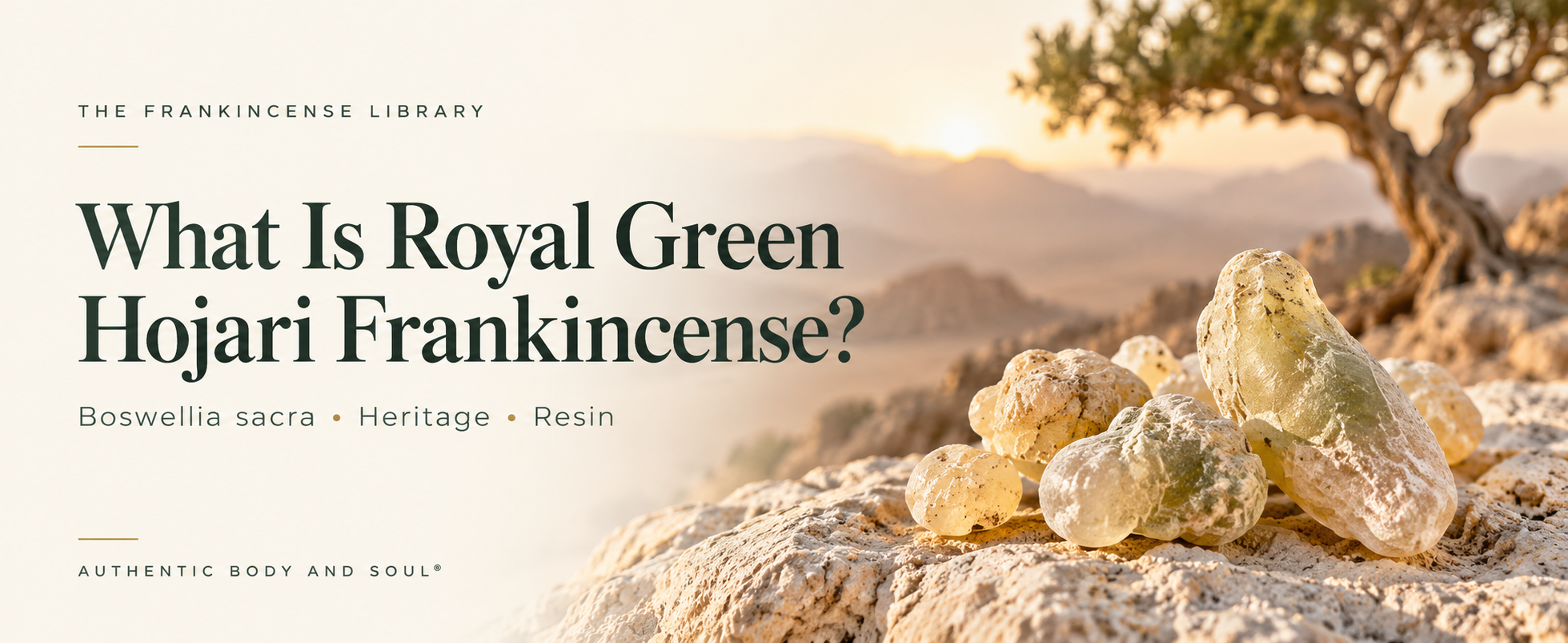
A small resin tear with a long history
There is something inviting about a piece of frankincense resin: its irregular shape, translucent edges and the way it catches the light. Getting to know it begins with its name.
Royal Green Hojari is a commercial description used for selected frankincense resin sold as Boswellia sacra. The botanical name identifies the tree species. Hojari describes a recognised commercial category of Omani frankincense; published research also uses the spelling Hoojri. The words “Royal Green” should be read as a seller’s selection description rather than a measured concentration of a chemical constituent. [1]
Its connection to Oman
Oman’s frankincense heritage is preserved in UNESCO’s Land of Frankincense World Heritage site. Its components include the trees of Wadi Dawkah, the caravan oasis of Shisr and the ports of Khor Rori and Al-Baleed. Together, they document the production and movement of frankincense across centuries. UNESCO identifies the frankincense trees at Wadi Dawkah as Boswellia sacra. [2]
That history makes provenance worth asking about. A resin’s story is clearer when its botanical identity and sourcing information accompany its commercial name.
What can grade tell us?
A grade can help describe a resin in trade, but it cannot answer every question about its chemistry.
In a 2012 study, researchers compared essential oils distilled from four commercial grades of Omani B. sacra. Hoojri and Shaabi differed substantially in price but had closely similar essential-oil composition and yield in the samples examined. [1]
This finding concerns those distilled oils. It does not establish that all grades have identical whole-resin chemistry, and it does not measure the composition of a particular skincare product.
For readers, the practical distinction is simple: appearance, commercial grade and a laboratory result provide different information. A beautiful green-tinged resin is not, by colour alone, evidence of a particular boswellic-acid percentage or a superior skin outcome.
Three questions worth asking
When learning about a frankincense resin, ask: What species is it? What sourcing information supports its identity? If a chemical percentage is advertised, what testing supports that figure?
These questions leave plenty of room to appreciate the resin’s beauty and heritage while making its description more meaningful.
Continue exploring: What Are Boswellic Acids?; Frankincense: Resin vs. Essential Oil; the Royal Green Hojari pillar guide.
Choose your next question:
-
Royal Green Hojari Frankincense:
A Guide to the Resin, Its Heritage and the Research
- Frankincense: Resin vs. Essential Oil — understanding different preparations.
- What Are Boswellic Acids? — the compounds and how researchers measure them.
- Frankincense and Skin: What Does Human Research Show? — a closer look at a human study.
References
- Al-Saidi S et al. Composition and antibacterial activity of the essential oils of four commercial grades of Omani luban, the oleo-gum resin of Boswellia sacra Flueck. Chemistry & Biodiversity. 2012. PubMed, PMID 22422529.
- UNESCO World Heritage Centre. Land of Frankincense. Heritage source; not a clinical study or product certification.