Royal Green Hojari Frankincense: A Guide to the Resin, Its Heritage and the Research
A botanical treasure becomes even more interesting when we understand its name, its origins and the questions scientists are asking about it.
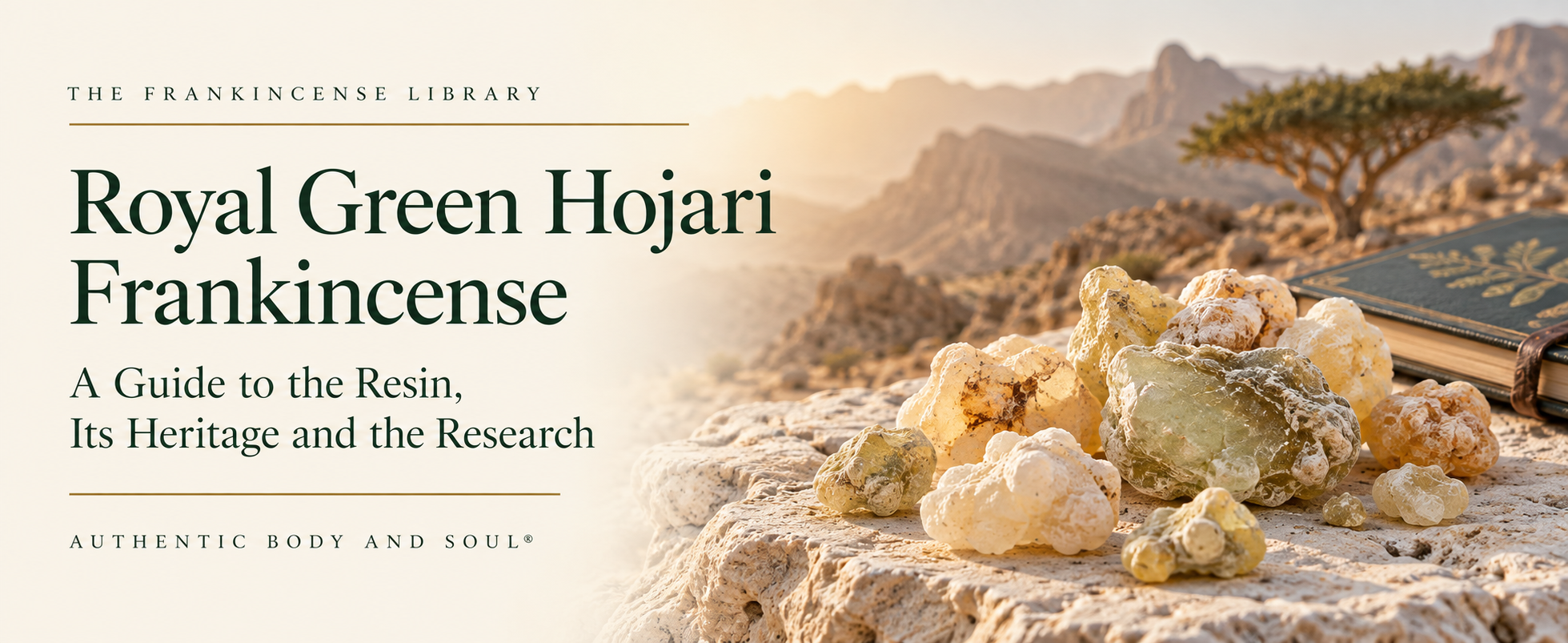
Pick up a piece of frankincense resin and there is already something to discover: an irregular edge, a milky surface, a translucent centre or a subtle green tint. Each tear invites a closer look.
Royal Green Hojari brings together several stories. There is the botanical story of Boswellia sacra, the tree associated with Omani frankincense. There is the heritage of resin gathering and trade. And there is a growing scientific literature examining frankincense constituents and particular preparations.
This guide brings those stories together, while keeping a useful question in view: what exactly are we looking at, using or studying?
What is Royal Green Hojari frankincense?
Frankincense is an aromatic material obtained from trees in the genus Boswellia. Several species produce commercially traded resins, so “frankincense” alone does not identify one botanical source. Kew’s botanical collections illustrate this diversity and the importance of identifying the source species. [1]
Royal Green Hojari is a commercial description used for selected Omani frankincense sold as Boswellia sacra. It helps to read the name in parts:
| Name element | What it tells us |
|---|---|
| Boswellia sacra | The stated botanical species |
| Hojari | A commercial category of Omani frankincense; also spelled Hoojri in research |
| Royal Green | A seller’s selection description, which needs to be understood alongside its sourcing and grading information |
The words “Royal Green” should not be read as a laboratory specification. A grade name does not, by itself, establish a boswellic-acid percentage, certify sustainable harvesting or demonstrate a clinical benefit. [2]
Explore further: What Is Royal Green Hojari Frankincense?
The Omani heritage behind the resin
Frankincense helped connect places and people long before it appeared in modern skincare.
UNESCO’s Land of Frankincense World Heritage site preserves four parts of that history: the trees of Wadi Dawkah, the caravan oasis of Shisr/Wubar, and the ports of Khor Rori and Al-Baleed. Together, they document a trading system linking resin production, inland transport and maritime exchange. UNESCO identifies the trees of Wadi Dawkah as Boswellia sacra, and records that frankincense continues to be harvested there. [3]
The heritage extends beyond the material itself. A resin tear also represents knowledge about trees, harvesting and handling, along with the communities that have carried that knowledge forward.
Frankincense’s place in religious and cultural traditions adds another layer. Kew discusses its associations with incense, gifts and historical trade, while also explaining how difficult it can be to identify the precise resins used in ancient settings. [1]
That uncertainty is part of the story. A modern commercial grade should not automatically be assigned to every historical reference to frankincense.
From the tree to a resin tear
Frankincense is often called an oleo-gum-resin. The name reflects a material containing an aromatic oil portion, gum and resin constituents. It is more chemically varied than the word “oil” might suggest. [4]
Harvesting commonly involves making controlled incisions in the bark and collecting the exuded material after it hardens. Research on B. sacra in Oman has examined how tapping methods, tree characteristics and growing conditions influence production. [5]
For someone learning about resin, this is a useful change in perspective: frankincense begins as a tree product, before it becomes an incense, an extract or an ingredient.
What does the green colour tell us?
Colour is part of the sensory appeal of frankincense. Kew’s collection includes specimens showing a wide range of colours and textures. [1]
But colour is an observation, not a chemical assay.
A 2012 study compared essential oils distilled from four commercial grades of Omani B. sacra. In the samples examined, Hoojri and Shaabi differed greatly in price but had closely similar essential-oil composition and yield. [2]
The finding concerns those distilled oils. It does not establish identical whole-resin chemistry across every grade or batch.
The practical lesson is to keep different kinds of information in their proper place. Appearance helps describe a resin. Botanical identification helps establish its source. Analytical testing answers questions about particular compounds. Clinical research addresses outcomes under defined conditions.
What are boswellic acids?
Boswellic acids are a family of related compounds found in certain Boswellia resins. They belong to a chemical group called pentacyclic triterpenic acids.
Names encountered in research include β-boswellic acid, KBA and AKBA. A measurement of AKBA alone is different from a measurement of several boswellic acids combined. Researchers have used chromatography and mass spectrometry to identify and quantify these compounds in B. sacra and B. serrata. [6]
Three details make a percentage meaningful:
- Which compounds were included?
- Which material was tested: raw resin, an extract or a finished formula?
- What basis and method were used to calculate the result?
A published result from one research sample cannot supply the concentration in an unrelated batch of resin or a balm made from it.
Explore further: What Are Boswellic Acids? Understanding Frankincense Beyond Its Aroma
Whole resin, essential oil, infusion and extract
These terms describe different materials and processes.
| Preparation | What it means | What to keep in mind |
|---|---|---|
| Whole resin | The collected oleo-gum-resin, often sold as tears or pieces | Its composition is not described by aroma alone |
| Essential oil | The volatile aromatic fraction obtained through distillation | It does not represent the whole resin |
| Oil infusion | Resin contacted with a carrier oil so that some constituents can transfer into the oil | The process alone does not establish a measured boswellic-acid concentration |
| Extract | Material obtained through a specified extraction process | The solvent, method and any standardisation affect what the term describes |
| Finished balm | A formula containing its chosen oils, waxes and other ingredients | Evidence for an ingredient is different from evidence for the finished formula |
Research on distilled B. sacra oil illustrates the aromatic fraction’s terpene composition. Separately, research distinguishes volatile terpenes from nonvolatile boswellic acids. Conventional steam or hydrodistillation should therefore not be treated as a way of transferring the whole resin’s boswellic acids into its essential oil. [4,7]
An oil infusion raises another question: how much of each constituent actually enters the carrier oil? That requires measurement. Knowing the starting weight of resin, or seeing clear oil after filtration, does not answer it.
Filtration removes suspended material to the extent permitted by the filter and process. Clarity alone cannot verify chemical composition, concentration or microbiological quality.
Explore further: Frankincense: Resin vs. Essential Oil
What does the research show?
Frankincense research spans different species, compounds, preparations and routes of administration. The following examples help orient readers; they are not a comprehensive review.
Skin & Barrier
A small study published in 2010 compared a cream containing 0.5% boswellic acids with the same cream base without those added compounds. Fifteen women applied the creams to opposite halves of the face once daily for 30 days.
The authors reported improvements in tactile roughness and fine lines, alongside instrumental changes including improved elasticity. [8]
The design offers useful preliminary human evidence for the cream studied. Its small sample and short application period limit broader conclusions. It did not test Royal Green Hojari resin or an Authentic Body And Soul® balm, and the reported outcomes do not establish skin-barrier repair.
Explore further: Frankincense and Skin: What Does Human Research Show?
Joints & Movement
A 2008 randomised, placebo-controlled trial examined an oral, AKBA-enriched Boswellia serrata extract called 5-Loxin over 90 days in people with knee osteoarthritis. The authors reported improvements in pain and physical function. [9]
This is research on a particular oral extract from another species. It cannot establish that applying a Hojari balm produces equivalent effects.
Brain & Nervous System
A 2008 study investigated incensole acetate, a frankincense constituent, and reported effects involving TRPV3 channels and behavioural responses in mice. [10]
This was preclinical work. It does not demonstrate that smelling Hojari resin or using a resin balm treats anxiety or depression in people.
Across all three areas, the preparation and study design determine what a finding can reasonably tell us.
How to read a frankincense study
Start with five questions:
- Which species or compound was studied?
- How was the material prepared and administered?
- Was the research conducted in cells, animals or people?
- What was the comparison, and how long did the experiment last?
- What outcomes were actually measured?
Then look for information about sample size, funding, author interests and independent replication.
A laboratory mechanism can suggest a research direction. A human trial can investigate outcomes in its participants. Neither automatically validates every product sharing an ingredient name.
When keeping a study note, add one final sentence: “This study leaves the following questions unanswered…” That small habit helps preserve both the finding and its limits.
Why sourcing belongs in the conversation
The future of frankincense depends on living trees and the people who work with them.
A 2025 field study in Oman examined B. sacra harvesting across four ecological zones. Its findings underline the importance of tapping practices, including control of cutting depth, spacing and periods without tapping. [5]
For buyers and makers, useful sourcing questions include where the resin was collected, how its identity is documented and what information is available about harvesting practices.
“Wild harvested” describes collection from wild plants. It does not, by itself, demonstrate sustainable management. A credible sourcing story becomes stronger as its supporting details become clearer.
Frequently asked questions
Is Hojari a separate species of frankincense?
Hojari is a commercial category associated with Omani frankincense. The botanical name used here is Boswellia sacra. Grade and species answer different questions. [2]
Is greener resin necessarily stronger?
Colour alone cannot establish a concentration or predict an outcome. A claim about chemical content needs appropriate testing of the relevant material.
Does “no added essential oil” mean there is no natural aroma?
No. Resin can contribute its own aromatic constituents. “No added essential oil” describes a formulation choice; it is not the same as “aroma-free.” [4]
Can a handmade resin infusion be assigned the percentage from a published study?
Only appropriate testing can establish its concentration. A figure measured in a study’s resin or extract cannot be transferred to a different infusion.
Does a study on boswellic acids prove a frankincense balm works the same way?
The study’s preparation, dose, route and outcomes must be considered. A finished balm needs evidence appropriate to its own claims.
Continue exploring the Frankincense Library
At Authentic Body And Soul®, our aim is to make botanical education useful, inviting and transparent. We want readers to enjoy the material’s history and beauty, find the original sources and understand what those sources actually show.
Choose your next question:
- Frankincense: Resin vs. Essential Oil — understanding different preparations.
- What Is Royal Green Hojari Frankincense? — botanical identity, trade descriptions and grade.
- What Are Boswellic Acids? — the compounds and how researchers measure them.
- Frankincense and Skin: What Does Human Research Show? — a closer look at a human study.
References
- Royal Botanic Gardens, Kew. Frankincense: resin with many stories. Read at Kew.
- Al-Saidi S et al. Composition and antibacterial activity of the essential oils of four commercial grades of Omani luban, the oleo-gum resin of Boswellia sacra Flueck. Chemistry & Biodiversity. 2012. PubMed: 22422529.
- UNESCO World Heritage Centre. Land of Frankincense. Read the heritage record.
- Al-Harrasi A, Al-Saidi S. Phytochemical Analysis of the Essential Oil from Botanically Certified Oleogum Resin of Boswellia sacra (Omani Luban). Molecules. 2008;13(9):2181–2189. Read the paper.
- Alamri MM, AL-Shanfari AB. Harvesting and agro-ecological zones effects on sustainability of Boswellia sacra in Oman. Discover Plants. 2025;2:113. Read the paper.
- Mannino G, Occhipinti A, Maffei ME. Quantitative Determination of 3-O-Acetyl-11-Keto-βBoswellic Acid (AKBA) and Other Boswellic Acids in Boswellia sacra Flueck (syn. B. carteri Birdw) and Boswellia serrata Roxb. Molecules. 2016;21(10):1329. PubMed: 27782055.
- Pharmacokinetics of a Natural Self-emulsifying Reversible Hybrid-Hydrogel (N’SERH) Formulation of Full-Spectrum Boswellia serrata Oleo-Gum Resin Extract: Randomised Double-Blinded Placebo-Controlled Crossover Study. Biological & Pharmaceutical Bulletin. 2024. PubMed: 39343544. Cited for the distinction between volatile and nonvolatile constituents.
- Pedretti A et al. Effects of topical boswellic acid on photo and age-damaged skin: clinical, biophysical, and echographic evaluations in a double-blind, randomized, split-face study. Planta Medica. 2010;76(6):555–560. PubMed: 19918712.
- Sengupta K et al. A double blind, randomized, placebo controlled study of the efficacy and safety of 5-Loxin® for treatment of osteoarthritis of the knee. Arthritis Research & Therapy. 2008;10:R85. Read the paper.
- Moussaieff A et al. Incensole acetate, an incense component, elicits psychoactivity by activating TRPV3 channels in the brain. The FASEB Journal. 2008;22(8):3024–3034. PubMed: 18492727.
- Posted in Boswellia sacra, Boswellic Acids, Botanical Heritage, Brain & Nervous System, Joints & Movement, Resin Education, Royal Green Hojari, Skin & Barrier